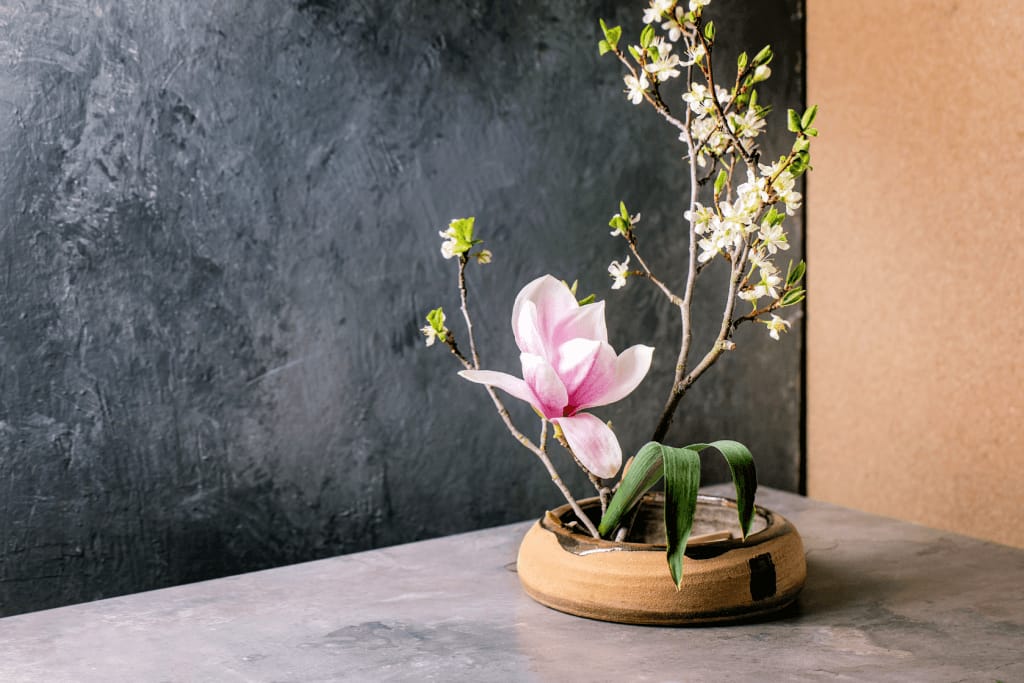
Ikebana is a Japanese style of flower arranging that represents minimalism & balance. The name comes from the Japanese words ikeru (to arrange to be living) and hana (flower). Together, the phrase roughly translates to “making flowers come alive,” which aligns with the Japanese ideology of living harmoniously with nature. Ikebana can be traced back to an ancient Japanese practice of decorating pieces of evergreen trees with flowers as religious offerings. After floral design became a decorative part of interiors, this art became a staple representative of Japanese design and culture.
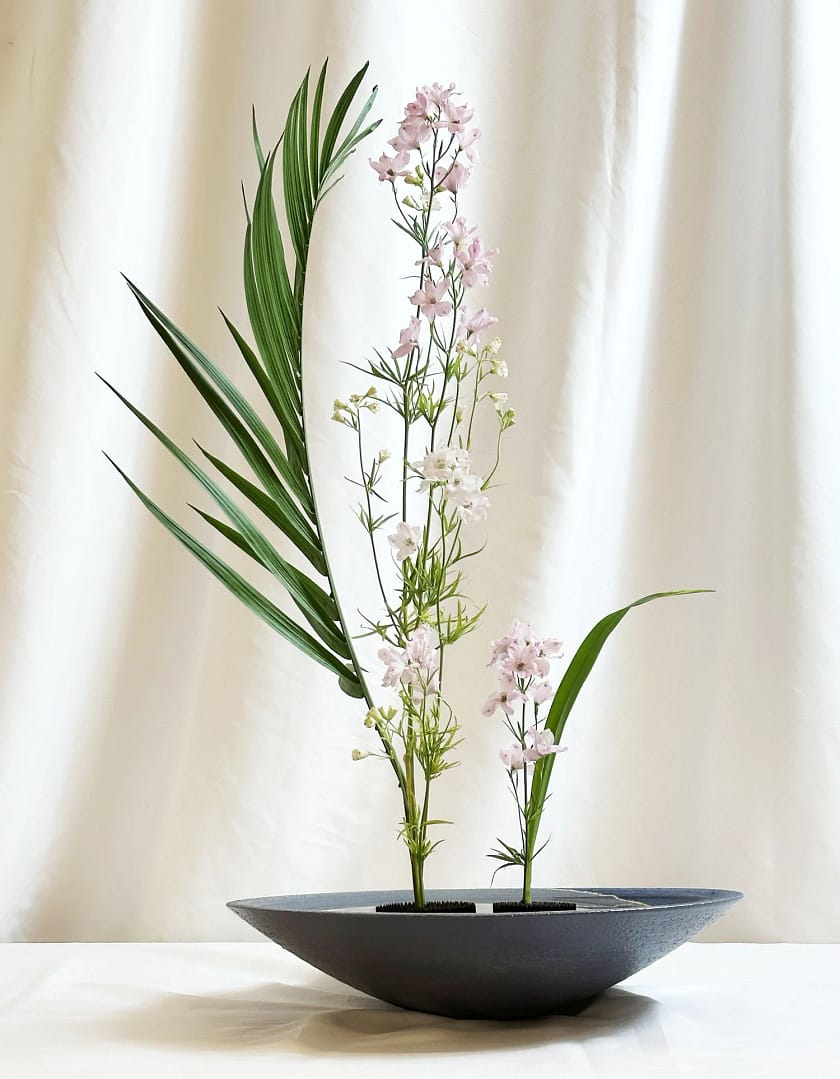
In ancient and modern Japanese culture, appreciation of the beauty of flowers has always been a key value. Ikebana evolved, the oldest technique being Rikka, which was meant to simply showcase the beauty of the natural elements used in the arrangements. More techniques emerged, like Shoka, which consisted of a triangular arrangement of the flowers, and Moribana, where the arrangements were spread wider and typically placed in a shallow, elongated container. Over time, so many techniques and styles of ikebana have been created that schools have been founded over time to teach their own interpretations of the art.
Though the origins of ikebana date back to ancient times, it is still applied to Japanese interior design. In fact, the design style has risen in popularity in recent years in Japan, where many modern schools have programs and clubs dedicated to the art. There are also displays of it in many popular Japanese events, one being the annual celebration of flowers and ikebana held in the Nijo Castle in Kyoto. Physical and digital showcases of arrangements are displayed, many created by designers from Ikenobo, the largest and oldest school of the art. In modern times, the style of flower arranging has become more freeform and globally present, expanding the creative possibilities.
There are a few fundamental steps to the practice of ikebana, the first being the intricate process of choosing the pieces that go into an arrangement. Choosing flowers, containers, and foliage to accentuate the piece is equally important. For example, pairing thinner, flowering branches with more delicate flowers or pairing larger, more solid branches with dense flowers brings the beauty of asymmetry to life. These pieces should ultimately reflect the interior they are surrounded by and add a balanced feeling to the space. The next step includes curating the arrangement and putting the pieces together in a sensible order. The foundation of ikebana is typically asymmetrical, but that is only a place to start; it is the more intricate placement details that make the piece whole. Placing the arrangement into its container is the final step. In many styles of flower arranging, the container can be a way to hide the “less beautiful” bottom of the piece, where the stems meet. However, part of ikebana is highlighting the beauty of imperfection, so the bottom of the arrangement is usually kept visible.
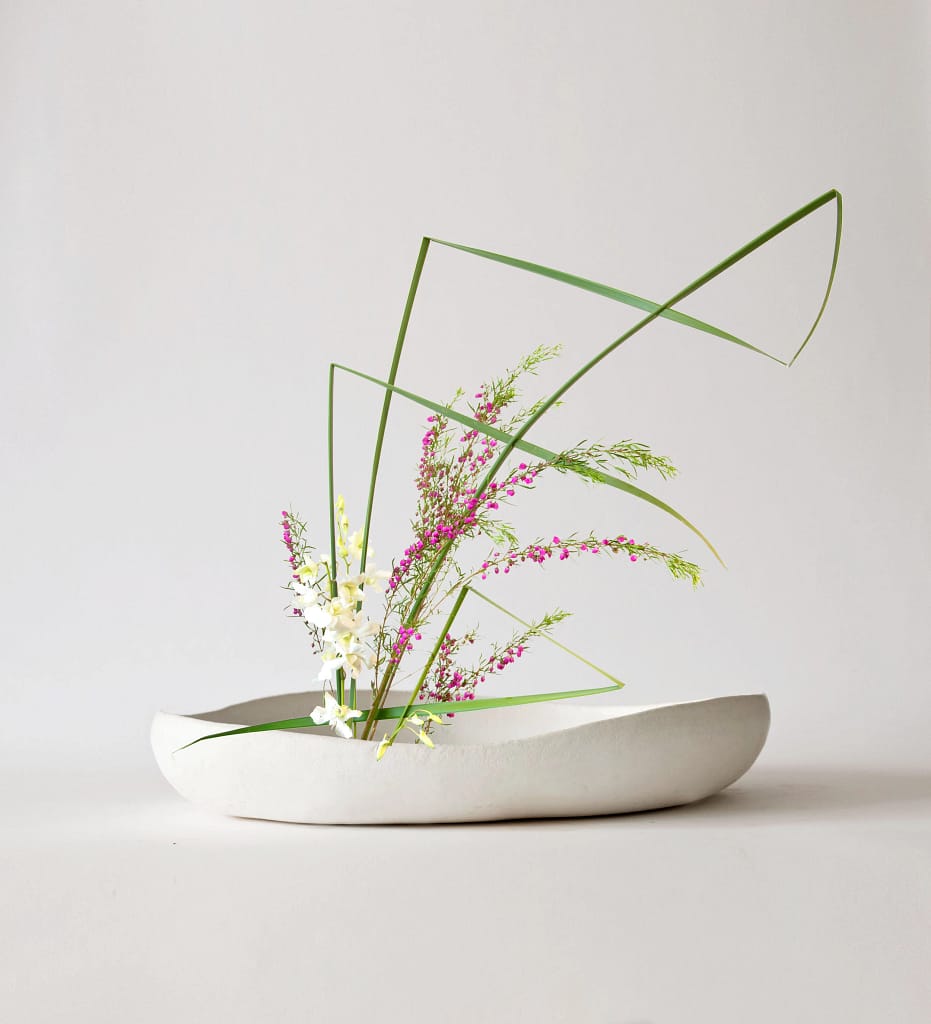
Creating a balance between interiors and nature is the principle of Ikebana, and to create an arrangement, one must first understand the philosophy behind much of Japanese design. The beauty in imperfection, the process of designing something in a minimalistic fashion to represent the elegance of simplicity, and the goal of reflecting the delicacy of nature and creating things that are harmonious with life. Ikebana is something each designer can approach and create in their own unique way, being true to the floral elements that they find beautiful.
Edited and Reviewed by Kien Powell
