
The Greek myth of Icarus is a famous one in its own right, but what if we add an extra layer to it?
A Little Backstory
For those who don’t know, the myth of Daedalus and Icarus is about a son and father who is trapped in a cell by King Minos. To escape, Daedalus crafted wings for himself and his son, out of feathers and wax. By the time the wings were finished, Icarus was eager to make it out of the cell. He was ready to explore the world. However, before taking off, Daedalus warned his son not to fly too close to the sun. For if he does, his wings will melt, and he will fall from mid-air. Once in the sky, Icarus becomes a bit ignorant and forgets about his father’s warning. Flying higher and higher, Icarus ended up too close to the sun and ultimately, just like his father stated, his wings began to melt and fall apart. In the end, Icarus ended up plummeting to the ground and dying.
The Analysis
This story was a huge influence on the famous saying, “Don’t fly too close to the sun.” In context, this saying is mostly used when you want to tell someone not to become egotistical about something. More so, if you try to push for too much, you are more than likely going to fall.
Not only did this story inspire a saying, but it also inspired artists. More specifically, a Renaissance artist named Pieter Bruegel.
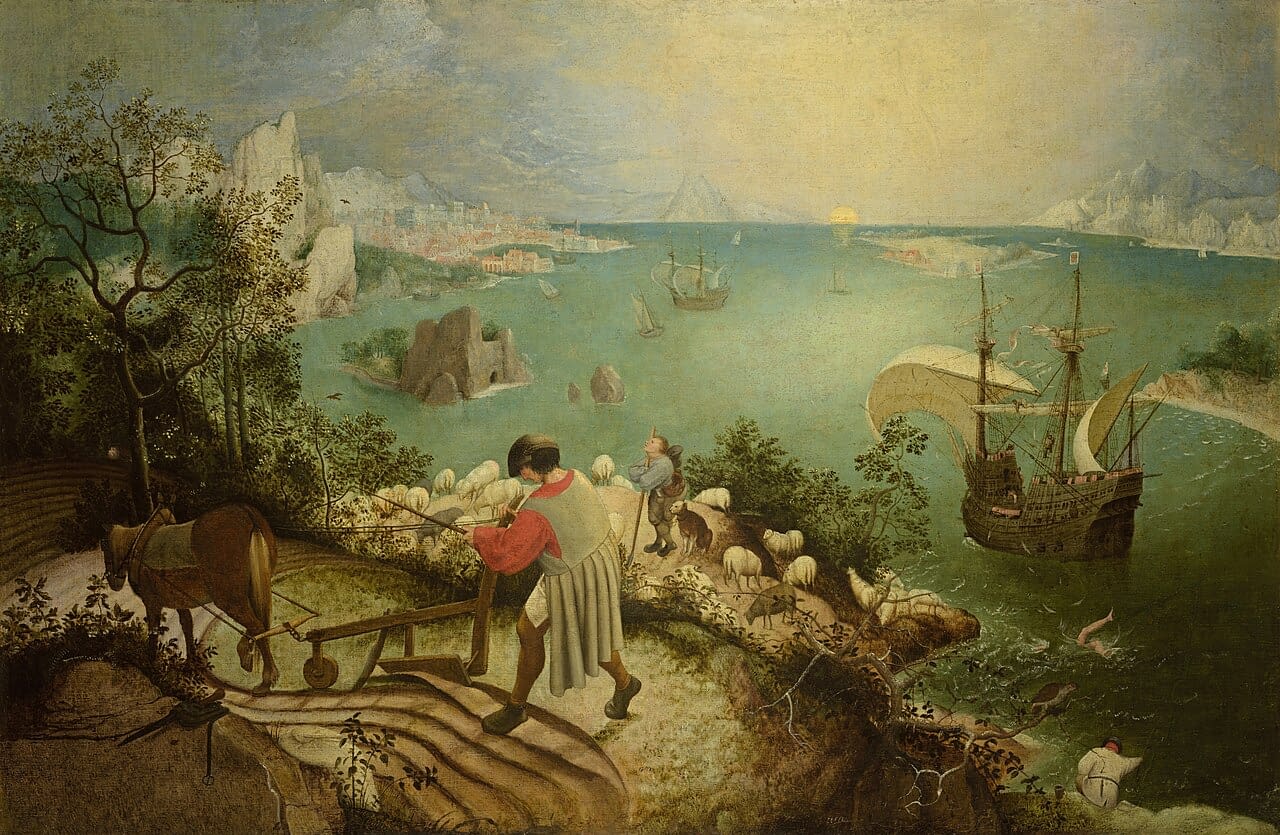
Now, what’s interesting about this painting is that at first glance, it doesn’t quite look like Icarus is the center of focus. It mainly just looks like a beautifully painted landscape. However, if you look in the ocean at the bottom right, you can see two legs. One is still quite a bit out of the water, and one is just beginning to become submerged.
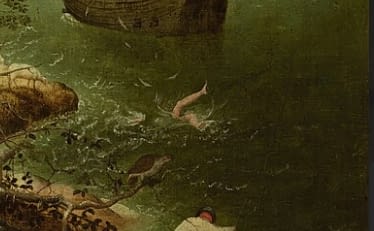
This is the ending fate of Icarus, well, at least according to this painter, it is. So, if the painting is inspired by the myth, why isn’t Icarus the more centered focus? That’s exactly what the painter wanted to get across. When looking at the painting, you may notice that everyone and everything else in the landscape seems to go on about their business. The farmer continues to plow his field, and the shepherd continues tending to his sheep. The prey animals that have an instinct to pay attention to every little detail to survive also pay no attention. Even the ship with its sails at full mast pays no attention to the boy who just lost his life. Brugel’s interpretation leads to another warning. While you may strive for greatness or to ‘fly high,’ the world will not pause to take notice. On the other hand, you may fail greatly, but the world will not stop in shock. This idea adds a sense of realism to the myth. It challenges the idea that our personal ambitions are the center of the universe.
This painting, in addition to the myth, ultimately isn’t just about pride but also perspective. They remind us to balance ambition and wisdom, confidence and caution, and dreams with awareness of reality. When we try to “Fly too close to the sun,” we run the risk of losing everything. Not just our success, but also the recognition we believe we deserve.
Works Cited
Chaliakopoulos, Antonis, and Emily Snow. “The Myth of Daedalus and Icarus: Fly Between the Extremes.” TheCollector, 6 September 2021, https://www.thecollector.com/daedalus-and-icarus/. Accessed 25 February 2026.
Zaczek, Iain. “Landscape with the Fall of Icarus | painting attributed to Pieter Bruegel the Elder.” Britannica, 20 February 2026, https://www.britannica.com/art/Landscape-with-the-Fall-of-Icarus. Accessed 25 February 2026.
